Showing posts with label Ask Kat. Show all posts

Monday, November 10, 2014

Orchard Road Mason Jars

A friend of mine told me about a new manufacturer of Mason Canning Jars called Orchard Road.  I am a lover of jars and just had to find out more about them so I searched the web and found  their website.    I contacted the company about their jars and they sent me some samples to try and see how I liked them in comparison to others I had used.  I am doing this post to tell you about this GREAT NEW JAR, but before I recommended it to others I wanted to get an answer to a few questions.


I ask them where their product was manufactured because I know that most of us love to buy American made products.  The person getting back to me with my information is Mike Furmanski and here's the answer he gave me when I ask about where they were made.

Our products do come from China.  There wasn’t a USA supplier willing to make the small quantities we needed to get started as a company.  I worked at Jarden Home Brands(Ball Kerr) for 12 years so I understand the importance of quality in these products for the canning process.  Our jars are slightly heavier than a Ball jar giving it a higher thermal shock rating and our lid manufacturer has been making canning lids for over 6 years and the plastisol(Sealant) comes from Pennsylvania. 


I ask him if the lids were BPA free.  Here's his reply.

           Yes our lids are BPA FREE, we will be calling that out with our next packaging run.

Finally I wanted to know if the jars contained any lead. He gave me a full explanation. Yes they do contain some lead. Here's how he explained it.

  Yes, our jars just like Ball jars do contain lead. Our level is 13 parts per million while the Ball Jars we tested were 23 parts per million. Both underneath the 100 per million threshold as an acceptable level. Lead is not in the raw materials of glass but in the heating process lead does transfer to the glass. We have test results if you’d like to see those but I’m including a comment from the chemist who did the testing below.


Click to read the Chemist comment 

With this information I feel good about recommending their jars. I am hoping to see them prosper and one day soon be able to have them manufactured in America.

Now to tell you a few things that I like about the jars.

Great Simple Design

They are simply designed with smooth sides except for the name. This is a great feature for those of us that like using pretty labels on our jars.


Yes, they did great in the Water Bath
I made Apple Pie Jam and it was a huge success!


I felt the real test of quality would come from pressure canning so I chose to try some pumpkin for this. This pumpkin was canned for 55 minutes at 10 pounds pressure using both Orchard Road and Ball Jars.  The jars did great!


What about the lids?  
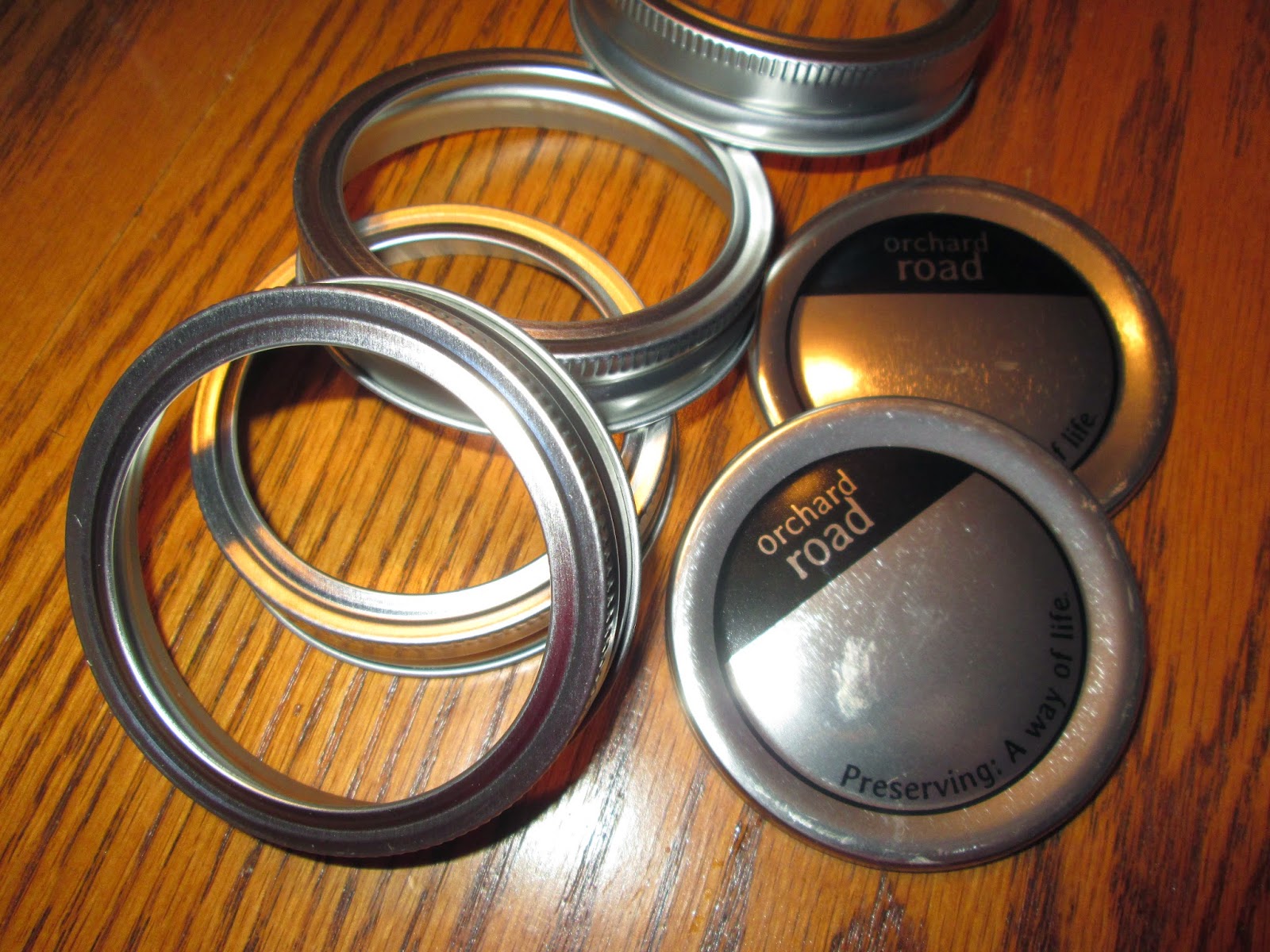
The lids have a nice design leaving plenty of room for you to use a sharpie and write in the date and name of what's in the jar.  All of my jars sealed and after a month on the shelf they are still sealed.  They are standard size lids and rings and will fit other regular mouth jars.

Packaged to prevent breakage

They are packaged well to prevent breakage  and come six jars to a carton.


Sizes Available

Wondering where you can buy these great new jars.  Just visit their site.


Wednesday, October 29, 2014

Presto Canners

Converting your Dial Gauge Canner to a Weighted Gauge Canner

I recently advised someone that they could use the 3 piece weight set sold on Amazon to convert their Dial Gauge Canner to a Weighted Gauge Canner and this started a discussion about whether or not is was safe to do this.

In order for me to 100% clarify that it was safe to change the regulators I contacted Presto and ask them them about this.   As you can see from their reply, it is safe to use the 3 piece weight set to convert your Dial Gauge to a Weighted Gauge Canner.  I hope this information will be helpful to all of you.

So if your Presto Canner came with the dial gauge and the 15 pound regulator that looks like this photo.


Then you can buy the 3 piece set that looks like this photo to use on it


If you use the 3 piece set you will not need to monitor your dial gauge, When the regulator is gently rocking that will tell you that your are at 5, 10 or 15 pounds of pressure.


This is what I ask them in my email:

Can you please let me know if the 3 piece weighted regulator set sold on amazon will work with my 23 quart canner model number 0178107 and my 16 quart canner 0175510.  I know that I can't remove the gauge but want to use the weighted regulator.  Here's a link to the one I am speaking of.

Click here to see the 3 piece weighted set on Amazon

Here is their reply to me:

Hello Kathy,

Yes, part 50332 will fit on the vent pipe of the model 0178107 and 0175510 canners.  However, depending on your altitude it may not be necessary to purchase the 3-piece regulator.  If you wish to use the canner as a weighted gauge canner then you will use 10 pounds of pressure for all low acid canning for However, depending on your altitude it may not be necessary to purchase the 3-piece regulator.  If you wish to use the canner as a weighted gauge canner then you will use 10 pounds of pressure for altitudes up to 1,000 feet.  But it you live above 1,000 feet you need to use 15 pounds of pressure.  The pressure regulator on the 23-quart canner is a 15 pound weight, so you could use the canner as it is.

When using the canner as a weighted gauge canner the rocking of the pressure regulator is the indication that the selected pressure has been reached inside the canner.  At that point begin counting down the processing time and adjust the heat on the stove so that a very slow, but continuous rocking motion is maintained for the duration of the processing time.  Do not compare or try to use the weight and gauge simultaneously.  Use only the movement of the variable weight as your indication that pressure has been reached and is being maintained.

If you have questions about this response please get back in touch.

Sincerely,
Nancy
Home Economist
nbecker@gopresto.com
800-368-2194

Wednesday, October 22, 2014

Canning Nut Meats

A recent discussion on canning nuts and recipes containing nuts prompted me to contact NCHFP for help in clarifying a few things.  Many recipes call for nuts as an ingredient and some of those in the discussion thought the recipes may no longer be safe and just had not been pulled from NCHFP website.    I received the answer from them and hope it will be of help to all of you.  As I said before, canning nuts alone is no longer recommended, but if a recipe calls for nuts then the recipe is safe as long as it is a tested recipe.

Dear Kathy,

Thank you for your interest in the National Center for Home Food Preservation. Regarding your question:

There has been a big discussion in a canning group that I am in concerning the safety of canning nut meats and recipes containing nuts.  I hope you can help me clarity the issue.  I explained to them that nchfp no longer recommends water bath canning nut meats alone but that they should freeze them.  I gave them the following link for a reference.


 Some of them believe that recipes like conserves calling for nuts are now no longer safe to make and can and that nchfp just hasn't pulled the recipes and updated their web site.  I explained that if you are using a tested recipe from nchfp or the Ball Blue Book and the recipe calls for nuts then that particular recipe is ok to can.  Can you please give me an answer on this to clarify this issue.   


You are correct, it is only particular canning procedure for a dry pack of shelled nut meats we withdrew:

I explained to them that nchfp no longer recommends water bath canning nut meats alone

This was not intended to be any recommendation regarding other products such as conserves that might contain some nuts. We only recommend
 canning recipes, procedures, and process times that have a scientific, research-based determination. Let's consider our recommendations for conserves with nuts, such as Apple Conserve: http://nchfp.uga.edu/how/can_07/apple_conserve_powder.html for example -- these recipes, procedures, and canning processes were developed with that called for amount of nuts. Rather than just nuts alone, there are other ingredients that influence the characteristics of the final product. Apples are an acid food and lemon juice is a strong acid, increasing the acidity of the final product. Pectin and sugar combine with this acid and fruit to make a gel, which reduces the water activity of the final product. These characteristics make a difference in the canning process. For a more detailed explanation of how canning processes are determined, please read this backgrounder: http://nchfp.uga.edu/publications/nchfp/factsheets/heatprocessingbackgrounder.html .

We also update recommendations when new research reveals previously unknown concerns. In the case of canning nut meats, concerns arose due to the increase in Salmonella problems in some nut products such as we have seen over the last few years. In just the past few years, there has been new research about different species of Salmonella and their tolerances for some drier (low water activity) conditions. Based on this information, canning nutmeats in a dry pack could be potentially hazardous using the directions we formally had if any condensation or moisture pockets formed inside the jar. That previous canning process was really a way to create a vacuum-sealed jar and there is no documentation for any microbial sterilization that might have been taking place.  So, without the science to support it, and in the face of concerns from microbiologists should moisture condense inside the jars, we no longer have a recommendation for canning nutmeats at home in the dry pack in a boiling water canner (or by any means)​​.  We are unable to study this issue in home canning at this time.  There are other options today for vacuum packaging of dry shelled nutmeats than there were when that process was first published.

As an aside, nutmeats stored in a freezer in a dry pack should not go bad or spoil once the electric goes out.  Nuts do not even have to be stored in the freezer; it is a way of extending the quality over storage time but not necessary for safe storage.

You can also contact Ball to find out their testing protocol for their recipes ( http://www.freshpreserving.com/contact-us ). Ball does conduct product testing, but not everyone who writes canning recipes does; you can always try contacting authors and companies in order to find out their testing protocol (or lack there of). We suggest using canning recommendations only from reliable sources who have conducted product testing.

Best wishes,
Kasey Christian

Tuesday, September 23, 2014

Ask Kat


I want to hear from you.  Please feel free to send any questions that you have by filling out the form below and I will be happy to help you.  Have a blessed day!


Your Name :

Your Email: (required)

Your Message: (required)

Monday, September 1, 2014

Re-Canning Food

I have a large gallon size container of peaches, can I open them and re-can them in pint jars?

I don't recommend re-canning commercially canned food unless it is something you are using in a recipe that you are going to can.  However, I found 2 different answers to this question.  I am giving both answers here FYI.  I believe the folks at All American are speaking of fruits only.  It is not usually cost efficient to re-can anything.

The first one is from the All American Canner Manual FAQ's
Q. When canned or frozen fruits are bought in large containers, is it possible to can them in smaller containers?


A. Any canned or frozen fruit may be heated through, packed, and processed the same length of time as recommended for freshly prepared food. This canned food may be of lower quality than if it had been canned when fresh.


Listed below is what the National Center for Home Food Preservation has to say about re-canning food

Is it safe to jar already canned food?
Often people think that they can save money by buying larger containers of canned food, transferring the contents (or leftovers from the first use) to smaller jars and re-processing it. Others wonder if this is a way to save leftovers from any size can for a longer time than they will keep in the refrigerator. 

There are several problems with these practices: 
(1) We have no safe tested processes to do this. In some cases, the way the heat is distributed throughout the jar during canning will be very different if you start with already canned/cooked food than with fresh. Excessively softened foods will pack more tightly into a jar, or arrange themselves differently and the process time recommended for fresh foods will not be enough for the already canned foods. Underprocessing can lead to foodborne illness or at the very least, spoilage and loss of product. You definitely could not just transfer the food and "seal" the jar. You would need some heat treatment known to destroy any organisms transferred with the food. 

(2) The expense and time of recanning foods far exceed the cost savings of bulk or large-quantity packaged foods. To re-can food, you now add the expense of a jar and lid as well as the energy to re-can the food. 

(3) Most likely the quality of the food will be greatly reduced in canning the food for a second time. The heat of canning does cause loss of some nutrients, and a second round of canning will further reduce the nutritional value. Textural changes from heating will be added to those already produced. 

Without tested processes for re-canning foods, there is no way to know how to reduce the canning process and the default (although not a recommendation) is to process for the full time and temperature as if starting from scratch. When you consider you are not even saving money and resources, it does not seem worth the loss of food quality to practice this re-canning of commercially canned food. Our recommendation is to not plan to do this.

Sterile Jars

Question:  Is it necessary to sterilize jars before canning?

Answer: Jars do not need to be sterilized before canning if they will be filled with food and processed in a boiling water bath canner for 10 minutes or more or if they will be processed in a pressure canner. Jars that will be processed in a boiling water bath canner for less than 10 minutes, once filled, need to be sterilized first by boiling them in hot water for 10 minutes before they're filled.


Reference:  National Center for Home Food Preservation

Of course you should still wash them in warm soapy water and keep them warm until ready to fill.  Kat

Saturday, July 26, 2014

Water Loss During Processing

Q. Why do my jars lose liquid during processing?
A. There are several reasons that will cause water loss during processing.

You packed your jars to tightly or overfilled them.  Don't shake down your jars.  Food needs room to expand during the canning process.  Make sure you leave the correct head space.

You did not exhaust your canner for the right amount of time

Your pressure regulator on the weighted gage canner rocked to vigorously.  Always maintain a slow, steady rocking motion.

If your heat source was unsteady or you had a steam leakage it may have caused a fluctuation of pressure during canning.

You should never try to speed up the cooling down time.  Let it drop on it own.  Bumping the regulator will cause water loss in your jars.

Uneven temperature changes is another culprit that causes water loss. You should always wait 10 minutes after pressure has dropped before removing jars from canner.

Your  lids may not have been adjusted on the jars properly.

If all canning procedures have been followed and the lids have sealed, the food is safe to store and eat. However, because liquid was lost during canning, food above the liquid line may discolor during storage. Plan to use these jars first.

Wednesday, October 2, 2013

Do I need to add Lemon Juice to Applesauce?

I recently answered a question in a canning group as to why The Ball Blue Book and the Ball Website have different recipes for making applesauce.  The Blue Book doesn't say to add lemon juice to the sauce but the website does.  I explained that adding lemon juice just helps the sauce maintain a good color and that I would contact Ball for verification.  Below is the question I sent to Ball and their reply to me.  Lemon Juice in Applesauce is optional, but does help it to keep a good color over time.
 
Someone asked me why the Ball Blue book doesn't say to put lemon juice in applesauce and the recipe on the site says that you do put lemon juice in apple sauce. Here's a link to the one on the site. I told them the lemon juice was probably just to help the sauce maintain a good color over time but wanted to ask you about it to make sure. Can you give me an answer? Thanks for the help.
Ball® Canning & Recipes
11:28am
 
Ball® Canning & Recipes
Hi Kathy! You are correct! The lemon juice does act as a color protector. Either recipe will work for home canning, so it simply comes down to a personal preference. Thank you for the question.

Wednesday, July 31, 2013

Lids Buckled up during processing

Billie says:  Help!! Did a double stack canner of pint green beans. I can tell for sure 3 of the top ones the Lid is buckled UP on one side .....??????

Answer:
When buckled lids appear to warp or bulge upward under the screw bands.
There are several causes:
1:  Buckling that is apparent immediately after heat processing is caused by application of the screw bands too tightly. Two-piece home canning lids are made in two pieces for a very important reason: To release pressure and vent air from the jar during heat processing.
As the filled jar is heated, headspace pressure increases until excess air is vented from the jar. When the band is applied too tightly, there is no way for air to be exhausted from the jar. Consequently, the pressure build-up warps the lids and disrupts the seal formation

2:  If you boil the lids and soften the seal too much it may cause you to get a premature seal.

3:  If they bulge later on the shelf, it could be that the food has spoiled due to being processed wrong or for the wrong length of timeand gases have formed in the jars either warping the lid or breaking the seal.

Monday, July 15, 2013

Preparing Jars

Question:
Do I need to sterilize my jars before putting the food into them?

Answer:
Not always.  If your recipe is being processed for more than 10 minutes then you don't have to sterilize the jars.  The canner will do that during processing.  Your jars do need to be kept hot until you are ready to fill them to avoid jar breakage.  Putting hot food into cold jars can cause the jars to break.  I wash my jars in hot, soapy water and keep them in my canner and keep it simmering until I am ready for them.  If you prefer, you can run them through a cycle on your dishwasher and they will stay hot there until you are ready to fill them. 

Sunday, June 23, 2013

Why put butter in Jam and Jelly?

The following question was ask as a comment on one of my jelly recipes.  I thought it deserved a spot under Q&A so that if there are any other canners wondering the same thing, you would have an answer. 

Q: 
what purpose does the butter have in the recipe ? have you tried leaving it out ? Butter can turn rancid and I know it is a small amount but I would double/triple the batch for gifts.
TinaH
 
A: 
Butter helps reduce foaming when making jam or jelly. It is an optional ingredient and if you check the tips in your boxes of Ball Pectin and the Ball Blue Book you will find that it also tells you to use a little butter to reduce foaming.  I have never had a problem with any of my jams or jellies by using it. 

Tuesday, June 11, 2013

What do I do with all those onions?

Nancy asks:
I have to dig up my onions today but what am I going to do with them all??? Can I freeze whole onions to use PRN?

Answer:
Nancy, There are several ways to store your onions.
1:  You can freeze them. It works best if you cut them up and put on a cookie sheet and freeze for an hour or two, then store in freezer bags. This way they don't stick together when you start to use them. Frozen onions work best when used in soups or stews. They will be soft when thawed.
2: You can also can Carmelized Onions..yummy. 
3:  Dehydrate them.
4:  I have had people tell me that they ferment them in quart jars just like making kraut, and that they are delicious that way, but I haven't tried it
5:  You can also store whole onions for 6 to 8 months in a cool, dry place.  You can use mesh bags or even old pantyhose.  Hang them on a hook and use when needed.


You can google for Fermented Onions and find all kinds of ideas.


Friday, May 10, 2013

Preserving Asparagus

 
Dianne Peaslee asks:
So excited...just went to the garden and picked almost 6lbs of asparagus. It is coming so fast...If I cut it into like 2-3 inch pieces and blanch it do you think I could freeze it on a cookie sheet till frozen then put into zip-locks and mix other veggies for a DIY stir-fry mix...
 
Answer:
 
Freezing asparagus is one of the best methods of preserving the flavor.  Vacuum sealing is more preferred over other ways because removing the air will hinder freezer burn and help it to maintain a good color and the best flavor.  When you vacuum seal you don't need to blanch the asparagus.  You simply wash it and cut it to the size you want.  Place it in your bag arranging it so that the most space is filled and more air can be removed.  Freezing this way preserves the most color and flavor.  If you don't have a vacuum sealer then you can wash and cut your asparagus.  Have a pot of water boiling and blanch it for about 30 or 40 seconds.  Cool quickly and place on a cookie sheet.  Freeze for a few minutes and then place in freezer bags or freezer container.  Remove as much air as you can before sealing. 

Wednesday, May 1, 2013

Removing Wax from Veggies & Fruits

Teresa Moye Asks:
How do I get the wax off of store bought cucumbers? My daughter's batch that we made came out soggy and she had to through them away. Sad time

Answer:
Teresa there are many commercial products you can buy, but there is no need to do so.  All you need to do is let them sit for a few minutes in water and vinegar. The vinegar will soften the wax if you let them sit a few minutes. Rub with your hands or a cloth. For stubborn wax use a soft brush and scrub gently. You can also use a little baking soda as a scrub. Rinse well under running water.

Saturday, March 9, 2013

Nancy Asks:

 
Q:   I have a problem. Yesterday I scored a ton of jars that were in a 92 year old man's estate....old jars!!! Problem is they are filled with something that now resembles crude oil, and the rings (grrrrrrr she left them on!) are now rusted so bad I cant get them off! Some of the lids are so thin I can probably puncture them. One punctured while I was loading them and the most horrible smell came out of that jar. I REALLY want to save these jars, any ideas on how to get them loose?? One's dated 1979!
 
A:  Turn them upside down in hot, soapy water.  Leave for about 1/2 hour.  Check rims and if it still won't come off, leave a little longer.  Usually soaking in hot water will do the trick.  I use a jar opener that does wonders for tight lids.  Here's a photo of my little helper! 
 

Friday, March 1, 2013

Teresa Asks

Q: How do you make cinnamon apple chips?
 
A: Teresa..they are easy....Here's the real quick answer.  When I make a batch, I will post the recipe in detail with photos for you. 
1:  Preheat oven to 225. 
2:  Just slice your unpeeled apples very thin...
3:  Spread on a cookie sheet lined with parchment paper. Sprinkle with a little cinn/sugar and bake about an hour. (have a second cookie sheet set aside, and turn them over on it..makes it easier) and bake another hour. 
4:  Turn off oven and as it cools they will get crisp.  

Thursday, February 28, 2013

Donna Asks

Q:  I have a tub of lard.  (fresh pork lard) Can I freeze it?
A:  Yes Donna you can freeze lard and it will keep for a very long time.  You can do it in several ways.
     1: Simply put it in a plastic container, put on the lid and freeze
     2: Melt it, while hot put in canning jars.  Put on lids and rings.     Let cool and put in freezer. 
     3: Put solid lard in foodsaver bags.  Put a paper towel in top of bag.  Seal and freeze. 
I would NEVER recommend canning lard.   Freezing is the only way I recommend.

Clear Jel

Q: Can you use Clear-Jel in place of Pectin when making jam?

A: I have had a few questions about using Clear Jel in making jams. I want to assure everyone that you CAN use it instead of pectin. You may have to adjust your recipes and it may take a few trial and errors to get it right, but Clear Jel can be used. Here is a link to Washington State University's County Extension with some good information about it and some recipes.

Rhonda Asks

Q:  I finally found a chili recipe that's close to one that I used to have and am hoping to make it either tonight or tomorrow morning but I have a question. This recipe calls for a 16 oz. can of kidney beans and I'm wondering if the chili would be safe to pressure can after it's made? Since the beans were already commercially processed, it shouldn't cause an explosion, right?

A: Yes, you can use commercially canned beans when canning chili. I use pinto beans in chili sauce and kidney beans when I do mine. It turns out great and is alot like Wendy's chili.

Justine Asks

Q:  Has anyone ever canned something up and then is afraid to eat it?...lol. My daughter and I canned up apple pie filling 2 years ago and neither of us is willing to open the jar and try it! It looks funny. But then it might look fine we just dont know what "fine" is.A: Fruit very seldom goes bad unless your seal is bad. If it still has a good seal and it smells good, then it should be ok. I store all of my jars with the rings removed so that if the seal comes undone, you will know it. If you leave the ring on and the jar comes unsealed, it is possible that it will seal back and you would not know it had ever been unsealed.